The state of alt data · the people
Who shaped the conversation
Five years of Alternative Data Weekly points at roughly 2,100 sources with a nameable creator. I ranked them by year and watched the top of the list. Of the ten most-cited voices of 2021, eight are gone from the top ten today. The two who survived tell you what lasting looks like.
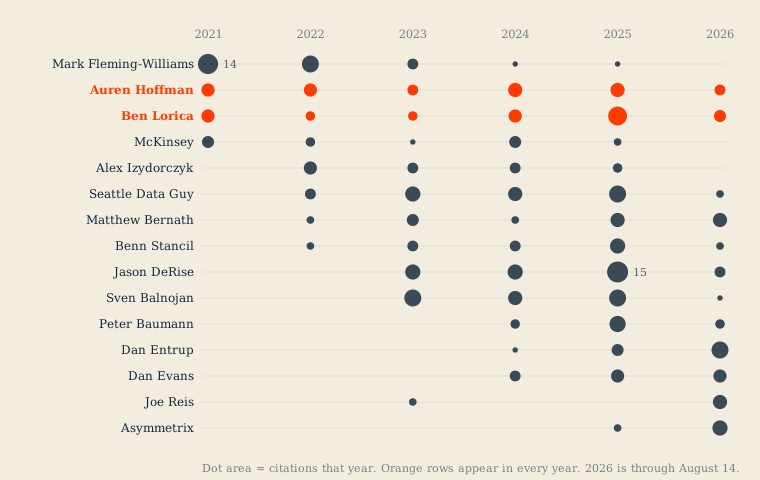
Eight of ten, gone
Here are the ten most-cited creators of 2021 next to the ten most-cited of the last two years. The overlap is two names.
| Most cited, 2021 | Most cited, 2025 to 2026 |
|---|---|
| Mark Fleming-Williams | Jason DeRise |
| Auren Hoffman | Ben Lorica |
| Ben Lorica | Dan Entrup |
| McKinsey | Matthew Bernath |
| Data Transformers Podcast | Seattle Data Guy |
| Data Science Central | Peter Baumann |
| Hedgeweek | Dan Evans |
| Deloitte | Auren Hoffman |
| Tobias Macey | Sven Balnojan |
| Explorium | Benn Stancil |
Everyone else at the top of the 2021 list has left the top of mine, and most have left the list entirely. That is not a knock on any of them. It is what a conversation looks like when the subject underneath it changes.
Three eras, three mediums
2021 and 2022 belonged to the podcast. Mark Fleming-Williams was my most cited creator both years, and it was not close: his Alternative Data Podcast was the place this industry explained itself out loud. Podcasts were 23% of everything I cited in 2021. Alongside him sat the institutions: McKinsey, Deloitte, Hedgeweek. The conversation ran through firms and shows.
2023 was the turnover year. ChatGPT rearranged the subject, and the list rearranged with it. Sven Balnojan, Seattle Data Guy and Jason DeRise took the top three slots. DeRise is the sharpest case: he does not appear in the corpus at all before 2023, then leads it in 2024, then posts 15 citations in 2025, the highest single-year count of anyone in six years.
2024 to now belongs to the newsletter. Individual writers publishing on their own mastheads are 31% of everything I cite this year, up from 9% in 2022. Podcasts are down to 3%. The unit of influence in this industry is currently one person, a publishing cadence, and a point of view.
The institutions left the room
Look at the 2021 list again: four of the ten are firms or platforms, not people. McKinsey alone earned 16 citations across five years. In the current top ten there are no institutions at all, and McKinsey has not appeared in the corpus this year.
I do not think the firms got worse. I think the format did. When the questions change every quarter, a byline with a Tuesday deadline beats a research department with a publication calendar. The people writing weekly earned the authority the decks used to hold.
The list refuses to settle
The churn is not history. It is happening now. The most-cited voice of 2026 so far is Dan Entrup, who entered the corpus in 2024. Behind him: Asymmetrix, Joe Reis, Jody Hesch, Matt Robinson, Dan Evans. Meanwhile Jason DeRise, the runaway leader of 2025, sits at four citations this year. One more turn of the wheel, in real time.
If the pattern holds, some of the names that will dominate the 2027 edition of this piece have not published their first issue yet.
The two constants
Ben Lorica and Auren Hoffman appear in every single year of the corpus, 2021 through 2026. Nobody else does.
What they share is instructive. Both changed their subject matter substantially across the period, Lorica from data engineering toward AI systems, Hoffman across the whole data economy, and neither changed their cadence. The lesson from five years of watching this list is not that consistency wins, and not that reinvention wins. It is that consistency of rhythm plus reinvention of subject is the only combination that survives every era.
Fixed voice, moving target. Nothing else survived all six years.
Method, and what this is not
This measures who I cited, one curator, weekly, for five years. It is a proxy for the industry's conversation, not a census of it. About 83% of citations carry a nameable creator; the rest are unattributed or institutional pages. Creators are resolved by merging name variants and by publication domain, and that resolution is slightly tighter than the one behind the August piece, so a few counts differ by small amounts from the leaderboard printed there. Same corpus, sharper merge, two more issues. 2026 figures are year-to-date through August 14.
Every citation behind every count is in the index, searchable by author and year, so the raw material is one search away.
Next Friday, and every Friday
Alternative Data Weekly
This piece came out of five years of a free weekly newsletter read by 4,600+ people in and around the data industry.